
One Base or Several? How We Plan Our Extended Stays In Europe
Every extended trip to Europe starts with the same question, and it has nothing to do with flights or packing lists. It’s about where you’ll actually sleep each night, for how long, and how many times you’ll pack up and start over. Get this decision right, and the whole trip feels relaxed. Get it wrong, and you’ll spend half your time hauling suitcases instead of enjoying the place you traveled to see.
There’s no single correct answer. One base works beautifully for some trips and would feel dreadfully long on others. Three bases can open up a region or wear you out completely, depending on the distances involved and how much moving-day logistics you’re willing to tolerate. The right structure depends on the destination, the length of the stay, and what kind of experience you’re actually after.
How We Decide How Many Places to Stay
Our extended European trips have evolved quite a bit over the years. The first time we decided to stay longer than our usual two-week vacation, we rented an apartment in Granada, Spain, for a month. At the time, that seemed like a pretty ambitious adventure.
Apparently, we liked it. The following year, we stretched our stay to roughly two months, and these days we’re usually pushing right up against our three-month Schengen allowance. Because naturally, once you’ve figured out how to spend a month in Europe, the obvious next step is to figure out how to stay even longer.
But here’s the thing: we’ve never wanted to spend those entire three months in one place.
For us, extended travel is about two things: experiencing what it’s like to live somewhere rather than simply visit, and seeing as much of Europe as we reasonably can. We want both, which means our itineraries usually combine longer apartment stays with shorter hotel visits along the way.
Not every destination makes a good month-long home base, though.
Before we commit to renting an apartment for a month, we ask ourselves whether the destination has enough to keep us interested for that long. We don’t need a major sightseeing excursion every day, but we do want plenty to explore.
What am I looking for in the perfect long-stay destination?
- Walkable streets
- Interesting architecture
- Shops
- Cafes
- Interesting neighborhoods
- Good public transportation (especially trains)
We don’t rent cars when we travel in Europe, except for the occasional weekend getaway to somewhere only accessible by car. Walking, trains, buses, and other public transportation are our preferred ways to get around. So if a destination requires a car to explore much beyond the immediate neighborhood, it’s probably not going to make our list of potential month-long home bases.
So the challenge isn’t simply deciding how many places to visit. It’s figuring out which destinations deserve a longer stay, which are better for a few nights, and how to combine them into a trip that feels both comfortable and interesting.
The Case for Staying in One Place
There’s something wonderful about spending enough time in a destination that it starts to feel familiar. You discover your favorite cafés and restaurants, figure out where to shop, and develop little routines that simply aren’t possible when you’re moving on every few days.
And sometimes, if you’re lucky, you find a place that keeps drawing you back.
For us, that place is Girona, Spain.
We discovered Girona almost by accident when we were planning one of our earliest extended European trips. We’d decided to spend a month in Valencia and were looking for somewhere to spend a second month. I was researching destinations like crazy, zooming around Google Maps and investigating towns and cities I’d never heard of.
Somewhere along the way, I came across a photograph of Girona’s beautiful medieval center. That was it. I was intrigued.
I’d never heard of Girona, much less considered spending a month there. But the more I researched, the better it looked. It was a manageable size, had the historic architecture I love, and I found an apartment right in the center that looked promising and fit our budget.
So we booked it.
Then we arrived.
We got off the train, climbed into a taxi, and started driving through an area that looked absolutely nothing like the beautiful medieval city I’d been admiring online.
I remember looking around and thinking, What on earth have I gotten us into?
Fortunately, about ten minutes later, the scenery changed. There, ahead of us, was the Girona I’d been expecting. And that was the beginning of a love affair with the city that’s lasted for years.
These days, Girona feels almost like a second home. We have our favorite restaurants, familiar routines, and even an apartment we return to regularly, rented from the same person.
That’s one of the greatest rewards of staying somewhere longer. You don’t just see a destination. You get to know it.
And there are practical advantages, too. Staying put means less packing and unpacking, fewer travel days, and more time to enjoy your surroundings.
Of course, that doesn’t mean we want to spend our entire European trip in Girona. There’s still far too much of Europe we haven’t explored. But returning to a place we love while adding new destinations to the itinerary has become one of our favorite ways to travel.
When Two or Three Bases Make More Sense
As much as we love settling into a favorite destination, spending two or three months in Europe without exploring somewhere else would be practically impossible for us. There’s simply too much we still want to see!
That’s why, ever since our first month-long stay in Granada, we’ve always divided our longer European trips among multiple destinations.
One year, we spent a month in Valencia, Spain, followed by a month in Girona. That first two-month trip, with a month each in Valencia and Girona, showed us how much we enjoyed experiencing two different parts of Spain without rushing through either one.
Another year, we spent a month in Lisbon, Portugal, and a month in Lucca, Italy. Both were wonderful experiences, and we loved having the opportunity to spend meaningful time in two different countries.
But here’s the funny thing. By then, Girona had become such a regular part of our travels that I actually missed it that year! Apparently, it’s possible to be having a fantastic time in Portugal and Italy while simultaneously wishing you were back in Spain. Who knew?
Our trips have also become more varied over the years. One itinerary included two weeks in Bergerac, France, a month in Girona, and another two weeks in Trieste, Italy, with additional stops along the way, a river cruise, and time in London at the end.
We often book hotels for several nights before our first longer stay, between destinations, and after our final apartment rental. Most years, we also include a river cruise toward the end of the trip.
For us, this combination offers the best of both worlds. We get to experience everyday life in a destination without giving up the excitement of discovering new places.
Of course, multiple bases aren’t right for everyone. If your idea of a wonderful extended stay is spending two months in one favorite city, there’s absolutely nothing wrong with that.
But if you’re like us and your list of places you still want to visit seems to get longer rather than shorter, dividing your trip among several destinations can be a wonderful way to experience more of Europe without turning the entire vacation into a race.
The Practical Trade-offs of Changing Locations
Of course, there’s a downside to visiting several destinations during an extended European trip. Every time you change locations, there’s packing to do, transportation to arrange, and another place to get settled into.
And while I love exploring new places, I can’t say that packing up an apartment after a month is my favorite part of the experience.
But over the years, we’ve learned to make those transitions part of the trip rather than something we simply have to endure.
Getting From One Place to the Next
One of the things I love most about traveling in Europe is the transportation. Give me a good train journey, and I’m a happy traveler. There’s something wonderful about settling into a comfortable seat, watching the countryside go by, and arriving right in the middle of another city.
But I’m also practical. We love Europe’s low-cost airlines, particularly Ryanair, which we’ve used many times. The fares can be astonishingly inexpensive, and some of these airlines serve smaller destinations that fit beautifully into our itineraries.
We choose between trains and flights based on the distance, connections, travel time, and overall convenience. Getting from Spain to Italy by train, for example, can turn into quite an undertaking. We’ve flown instead, saving time for the places we actually want to explore.
Of course, those bargain airfares aren’t always quite as cheap once you add luggage and other extras. So we look at the total cost and convenience, not just the advertised fare.
Why We Mix Apartments and Hotels
For longer stays, apartments make sense for us. We appreciate having room to spread out, a kitchen, and the ability to settle into something resembling everyday life.
But I have a confession: I love hotels.
I enjoy the experience of staying in a nice hotel, and I’m always happy when we can work a few hotel nights into our itinerary. In fact, our extended European trips almost always include hotel stays before, between, or after our longer apartment rentals.
Sometimes a destination only warrants a few nights. Other times, a hotel makes sense because we’re passing through on the way to somewhere else.
And occasionally, I simply want to stay in a hotel because I like hotels. There. I’ve said it.
Naturally, there’s a financial trade-off. Hotels can add considerably to the cost of a longer trip, especially when you’re traveling for two or three months. So we try to balance the comfort and variety of hotel stays with the practicality of renting apartments for longer periods.
The Cost of Moving Around
Transportation and accommodation costs are important considerations when deciding how many places to include in an itinerary.
Longer apartment rentals may offer better nightly rates than shorter bookings, but that isn’t guaranteed. We compare the actual costs rather than assuming that staying longer will always save money.
Changing destinations also means paying for trains or flights, local transportation, and sometimes additional hotel nights. Those expenses can add up.
Then there’s the less obvious cost: time.
A travel day isn’t necessarily a wasted day, especially when the journey itself is enjoyable. But it’s still time that could otherwise be spent exploring or relaxing in one place.
That’s why we don’t try to cram every destination on our wish list into a single trip. We want enough time in each location to enjoy being there, not just enough time to check it off a list.
For us, the trick is finding a balance between settling in and moving on. We love both experiences, and a thoughtfully planned itinerary lets us enjoy them without feeling as though we’re constantly in transit.
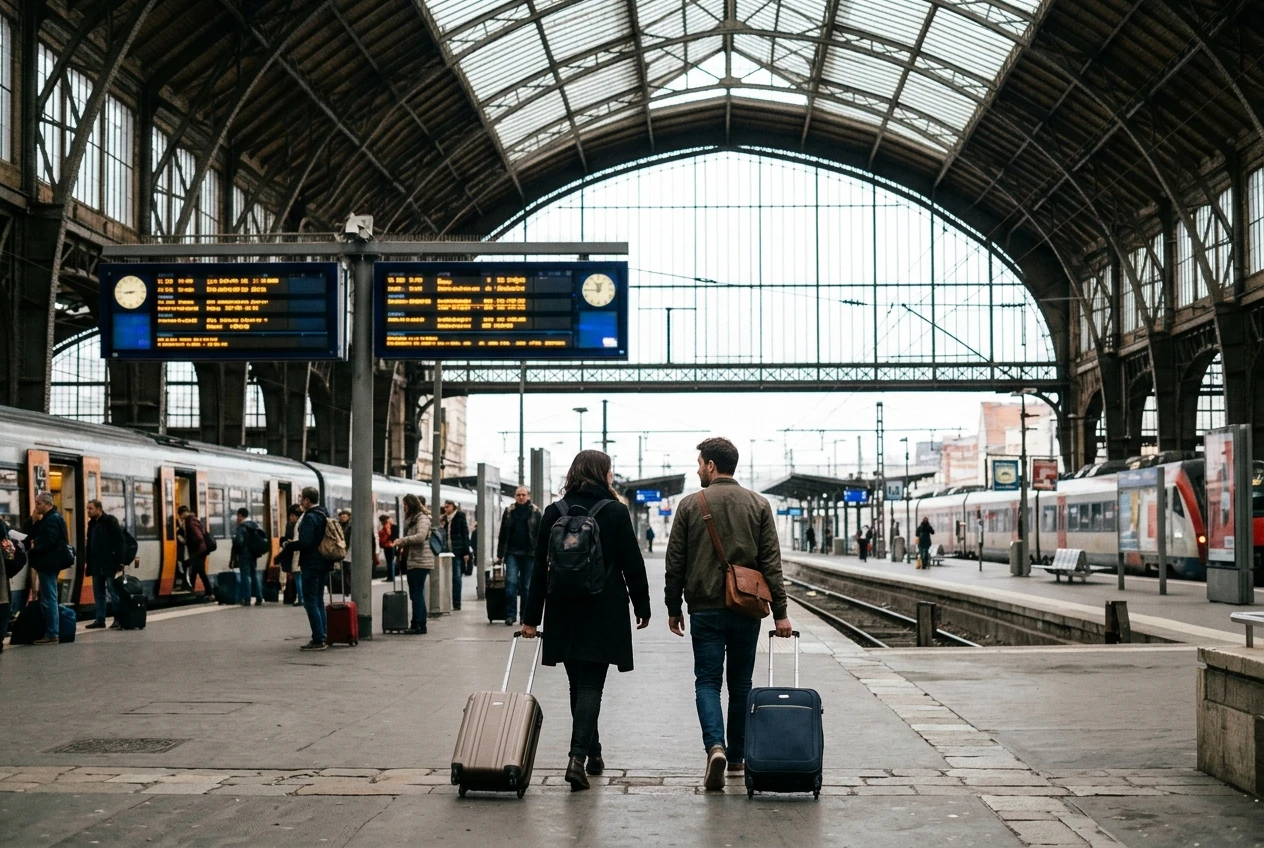
One Base or Several? It’s About Finding Your Travel Rhythm
After years of extended stays in Europe, I’ve learned that there’s no magic formula for how many places you should visit. Some travelers are perfectly happy spending two or three months in one location, while others would go stir-crazy after a couple of weeks.
We’re somewhere in the middle. We love having enough time to settle into an apartment, discover our favorite cafés, and feel like we’re actually living somewhere. But we also love exploring new destinations, hopping on trains, and occasionally treating ourselves to a nice hotel.
And frankly, after all these years, our list of places we still want to visit doesn’t seem to be getting any shorter. Quite the opposite!
My advice is to choose destinations that genuinely interest you, give yourself enough time to enjoy them, and don’t feel obligated to squeeze in more stops just because they’re nearby. The beauty of extended travel is having the freedom to create an itinerary that suits your interests, your budget, and your preferred pace.
For us, that usually means a combination of familiar favorites and somewhere entirely new. And if we can work in a few lovely hotels and a river cruise along the way?
Well, I’m certainly not going to complain.
