
What I Look for in an Apartment for a Month in Europe
Choosing a long stay apartment in Europe is a little different from choosing somewhere to sleep for three nights. For a short stay, I can overlook quite a bit. For a month? Not so much.
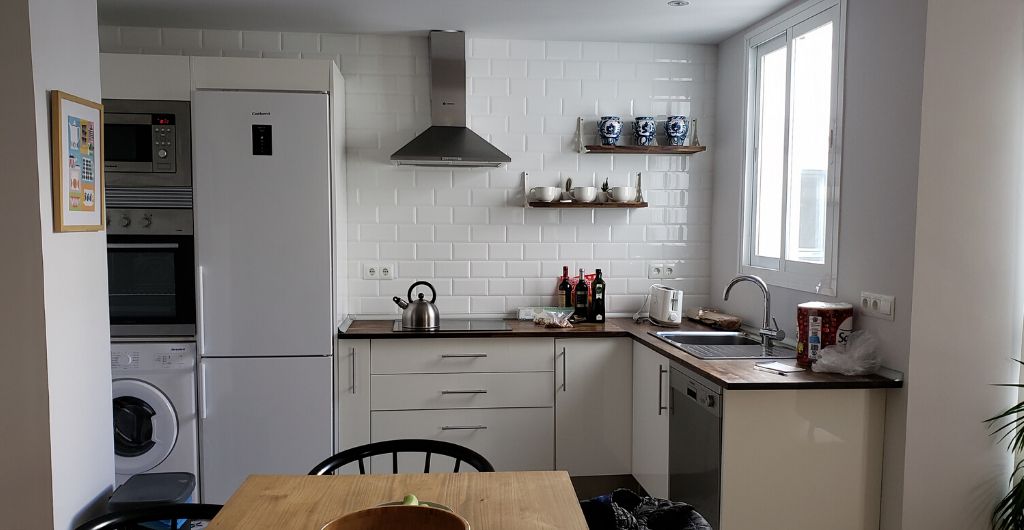
I want a kitchen. I want a washing machine. I want reliable Wi-Fi. I want enough room for both my husband and me to work. I want to be able to walk to restaurants, shops, and a grocery store.
And these days, if the apartment is more than one floor up, I REALLY want an elevator.
We learned some of these things through years of renting apartments in Europe. We learned others the hard way. Looking at you, freezing house in Granada.
Key Takeaways: Choosing an Apartment for a Long Stay in Europe
- Choose it as though you’re going to live there – because you are. A month is long enough for an inconvenient apartment to become very inconvenient.
- Location matters enormously. We look for walkability, restaurants, shops, groceries, and easy access to the places we’ll use in everyday life.
- Read every review. Noise, uncomfortable beds, cleanliness problems, and unreliable Wi-Fi tend to reveal themselves there.
- Don’t trust photos alone. Ask for the apartment’s actual size so you can compare properties more accurately.
- “Charming” and “cozy” aren’t always selling points. After years of rentals, we strongly prefer updated apartments with modern systems and amenities.
- For longer stays, comfort is worth paying attention to. Your accommodations can affect how you feel about the entire stay.
We Started Renting Apartments Because We Started Staying Longer
I’ve been traveling to Europe since the early 1980s, usually several times a year for trips that combined vacation with research for my travel business. But those were generally shorter trips – a week here, two weeks there – and hotels made perfect sense.
The apartment habit actually started in Mexico. Before we began our longer European stays, we had rented condos in Mexico for several winters. So when we decided to spend a month or more in Europe, staying in an apartment seemed like the obvious way to do it. And it was.
What about hotels, you may be wondering? The truth is, I love a good hotel. Actually, let’s not undersell this. I REALLY love a good hotel.
But for a month, an apartment is much more practical for the way we travel. We need room to work. We want to grocery shop and cook. We need to do laundry. We don’t want to eat every single meal in a restaurant.
We aren’t really on vacation for that entire month. We’re temporarily living somewhere else. And that changes what I look for.
Apartments are one of the things that make it practical for us to travel for months at a time while I’m still working.
My Non-Negotiables for a Long-Stay Apartment
After enough years of doing this, my list has become pretty specific. For a month-long stay, I generally want:
- A full kitchen
- A washing machine
- Reliable Wi-Fi
- Comfortable work space
- A central, walkable location
- Heat and air conditioning
- A queen- or king-size bed
- Two bathrooms, if possible
- An elevator if we’re more than one floor up
Two bathrooms aren’t always possible, of course, but our regular apartment in Girona has two, and I’ve become rather fond of that arrangement.
The elevator has become increasingly non-negotiable. We have hauled luggage up enough European staircases. It is not getting more fun with age.
Location May Matter More Than the Apartment
You can have the most gorgeous apartment in the world, but if you don’t like where it is, that gorgeous kitchen isn’t going to save your month.
When we’re staying in a historic town, I generally want to be right in the historic center. I want to walk out the door and be able to get to cafés, restaurants, shops, and a grocery store. We don’t rent a car, so walkability is especially important to us.
Being able to walk to the train station is nice, but that’s not a deal breaker. We can take a taxi when we’re traveling with luggage.
For a place we’ve never visited before, though, I study the map very carefully. I look at where the grocery stores are. I check restaurants and shops. I figure out what we’d actually have around us rather than relying on a listing that says the apartment is “centrally located.”
And yes, I Google the actual address and look at the street.
Because sometimes “centrally located” and “exactly where I want to spend the next month” are two very different things.
If the street looks sketchy? Next.
I Am Completely Over “Charming and Cozy”
There was a time when an old European house described as charming would have sounded delightful to me.
I’ve recovered. Thankfully, I’ve come to my senses .😂
These days, give me the historic city outside my front door and the modern, fully renovated apartment inside it. I particularly like apartments that have had complete renovations – modern kitchens, bathrooms, heating and cooling, electrical systems, windows, the whole thing.
There is a reason for this preference. On our very first month-long stay in Europe, we rented a house in Granada in February. It looked wonderful online, particularly because it had a large terrace overlooking the Alhambra.
What could possibly go wrong?
Well.
We hadn’t fully appreciated Granada’s elevation. That year it was experiencing record cold. It even snow flurried one day. In southern Spain.
Meanwhile, our charming old house was poorly insulated and heated with propane.
We froze.
There was considerably more to the story – including an argument over replacing the propane – but suffice it to say that the experience cured me of believing that charming automatically means comfortable.
It also accidentally started one of our favorite long-stay traditions. We were so cold that first weekend that we left Granada, went to another town, and checked into a hotel for a few nights just to warm up. We did it again the following weekend. And the next.
Eventually, little weekend trips became something we often incorporated into our month-long stays – although these days we generally take them because we want to explore somewhere new rather than because we’re fleeing our accommodations.
Progress.
Don’t Let Wide-Angle Photos Fool You
Vacation-rental photography can perform miracles.
A room that appears large enough to host a small wedding reception may turn out to have approximately four feet between the sofa and the kitchen sink.
So I want to know the apartment’s actual size. In Europe, that’s generally going to be given in square meters rather than square feet. That’s fine. I just want a number.
Knowing the size lets me compare one apartment with another instead of trying to determine from carefully angled photographs whether we’re looking at a spacious living room or an exceptionally talented photographer.
For a short stay, size may not matter much. For a month, particularly when two people are also working from the apartment? It matters.
Read. Every. Review.
I am obsessive about this.
Before booking an apartment, we read the reviews. All of them. I’m particularly watching for repeated comments about:
- Noise
- Bars or restaurants immediately nearby
- Wi-Fi problems
- Uncomfortable beds
- Cleanliness
- Stairs
- Problems with heating or air conditioning
- Anything that multiple guests mention
One complaint doesn’t necessarily scare me away. But if four different people mention that the nightclub downstairs plays music until 3 a.m., I’m going to believe them.
The same goes for Wi-Fi. When you’re working from the apartment, “Wi-Fi can be a little spotty” takes on a whole different meaning.
Look Beyond the Big Booking Sites
We originally found most of our apartments through Airbnb, and we still use it for some shorter apartment stays.
But our approach changed once we began returning to the same places.
Girona is the best example.
After staying there repeatedly, we got to know local rental agents. We now rent through the same agency and can get long-term rates rather than paying vacation-rental rates for an entire month or two.
We’ve also rented the same apartment in the same building for years.
Well…sort of.
Several years ago, our usual first-floor apartment wasn’t available for the first two weeks of our stay. The agency offered us another apartment on the third floor of the same building and said they’d move us downstairs when our regular one became available.
We weren’t thrilled. The photos of the upstairs apartment looked a little dumpy, but we reluctantly agreed.
Then we arrived. I opened the door and immediately smelled fresh paint. The entire apartment had just undergone a gut renovation. Everything was brand new.
We couldn’t believe it. We’ve been staying in that apartment ever since. Sometimes rental surprises work in your favor.
Compare the Same Apartment Before You Book
Here’s another thing worth knowing: the exact same apartment can sometimes appear on multiple booking sites at very different prices.
Don’t assume that the first place you find it is automatically where you should book it.
Search the apartment name. Search the address if you have it. Look for the rental agency or property manager directly.
For a longer stay, it’s also worth asking whether a monthly or long-stay rate is available. The nightly vacation-rental price multiplied by 30 isn’t necessarily what you should be paying for a month.
Once you start returning to a destination regularly, developing a relationship with a reputable local rental agency can be especially useful.
That’s certainly been our experience in a few places.
Your Apartment Sets the Tone for the Stay
I’ve heard people say: It doesn’t matter where I stay. I’m only going to sleep there.
For three nights? Maybe. For a month? Think again.
You’re going to wake up there. You’re going to come home there. You’re going to make coffee there, do laundry there, perhaps cook dinner there, work there, relax there, and spend rainy days there.
If you’re traveling the way we do, it isn’t simply somewhere you sleep. It’s your home for the month.
And if you hate being there, that’s going to affect how you feel about the trip. This doesn’t mean you need a luxury apartment. It means you need an apartment that works well for you.
So When Do We Stay in Hotels?
Oh, don’t worry. I have not abandoned hotels. 😂
We generally use them for shorter stops – a few nights in a city, a weekend trip during a longer stay, or anywhere it doesn’t make sense to settle into an apartment.
My unofficial cutoff sometimes comes down to a highly sophisticated travel calculation:
How long can we go without doing laundry?
There’s also one particular time when I actively prefer hotels: the end of the trip.
We call it our Exit Plan.
After spending a few months working and traveling around Europe, we like to finish with an actual vacation.
For several years, that has often meant a river cruise, followed sometimes by a few nights in a hub city before flying home. Paris in a nice hotel? I can be persuaded.
It’s a little luxury and R&R after what can sometimes be a hectic three months.
Apartment living makes the long stay possible. The Exit Plan makes leaving slightly less painful.
Our 2026 trip included plenty of moving around before we reached the Exit Plan – here’s what we managed to cram into those three months.
Frequently Asked Questions About Renting Long-Stay Apartments In Europe
Is Airbnb good for long-term stays in Europe?
It can be. We started with Airbnb and still use it for some shorter apartment stays. But if you’re staying for a month or returning regularly to the same place, look for reputable local rental agencies too. We’ve found that working directly with an agency can give us access to long-term rates rather than simply paying the nightly vacation-rental rate for 30 days.
Can you get a discount for renting an apartment for a month in Europe?
Often, yes. Some properties offer weekly or monthly rates that are lower than simply multiplying the nightly vacation-rental rate by 30. We’ve found this especially useful in Girona, Spain, where we now work with a local rental agency and rent at a long-term rate. It’s always worth asking before you book.
Do apartments in Europe usually have washing machines?
Many do, but I never assume. A washing machine is one of my non-negotiables for a long stay, so I check the amenities carefully before booking. And don’t automatically expect a dryer – those are much less common in many European apartments.
How far in advance should I book an apartment for a month in Europe?
For a specific apartment, popular destination, or longer stay, I prefer to start looking well ahead. Longer stays can be harder to fit into a property’s calendar because you need a large block of consecutive nights available. If your dates are flexible, you’ll naturally have more choices.
Before You Book a Month-Long Apartment in Europe
If you were about to book your first apartment for a month in Europe, these are the things I’d want you to remember:
Don’t choose it as though you’re booking somewhere to sleep. You’re going to live there for a while. Make sure you’ll actually enjoy being in it.
Investigate the location carefully. Don’t rely entirely on “central” in the description. Study the map, look for groceries and restaurants, and take a virtual walk down the street.
Read the reviews. All of them. Look especially for patterns involving noise, cleanliness, beds, Wi-Fi, stairs, heating, and cooling.
Find out how big it actually is. Wide-angle lenses have a lot to answer for.
Compare prices. The same apartment may be available through several sites, a local agency, or directly from the property manager – and the rates may not be the same.
And for a longer stay, ask whether there’s a monthly rate.
One month in Europe is long enough to settle into a rhythm. You find your grocery store. You have a favorite café. You know which streets you like walking down. You start recognizing people. That’s one of my favorite things about staying longer.
And having an apartment that actually feels good to come home to is a very big part of it.
Preferably one with heat. And an elevator.
